
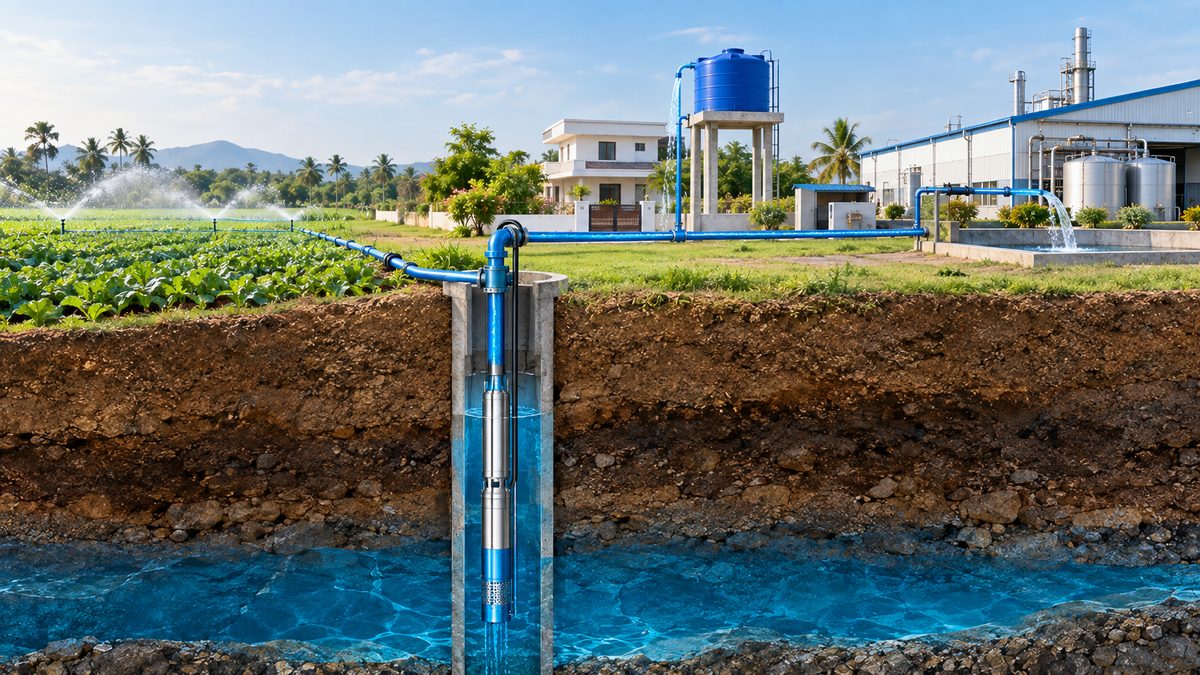
Choosing the right pump is important for homes, agriculture, commercial buildings, and industrial applications. A submersible pump works underwater and is designed to push water from wells, borewells, tanks, and other water sources to the required location. However, selecting a suitable model requires more than simply comparing prices.
If you are looking for a Submersible Pump in Coimbatore, consider factors such as water source, pumping capacity, head, motor power, construction quality, energy efficiency, and after-sales support. The right choice can provide reliable water flow while reducing maintenance and operating costs.
1. Identify Your Water Source
The first step is to understand where the pump will operate. Submersible pumps can be used for different water sources, including:
- Borewells
- Open wells
- Water storage tanks
- Agricultural water sources
- Residential water systems
- Commercial applications
- Industrial water requirements
The depth and type of water source directly influence the pump specification. A borewell pump, for example, may require different technical characteristics from an openwell submersible pump.
Before purchasing, measure the approximate water level, well depth, and distance to the delivery point.
2. Check the Required Pump Capacity
Pump capacity determines how much water the equipment can deliver within a specific period. It is generally expressed in litres per minute (LPM) or litres per hour (LPH).
For residential use, the requirement may be relatively moderate. Agricultural and industrial applications can require considerably higher water output.
Instead of selecting a pump based only on motor size, calculate your actual water requirement. Oversizing the pump can increase electricity consumption, while an undersized pump may not provide sufficient flow.
3. Consider Total Head and Lifting Height
Total head is another important factor when choosing a water pump. It refers broadly to the height and pressure the pump needs to overcome to move water from the source to the discharge point.
For example, water may need to travel:
The pump must have sufficient head capacity for the entire system.
A pump dealer or technical professional can help calculate the required head based on the depth, pipeline length, pipe diameter, bends, and discharge requirements.
4. Choose the Correct Motor Power
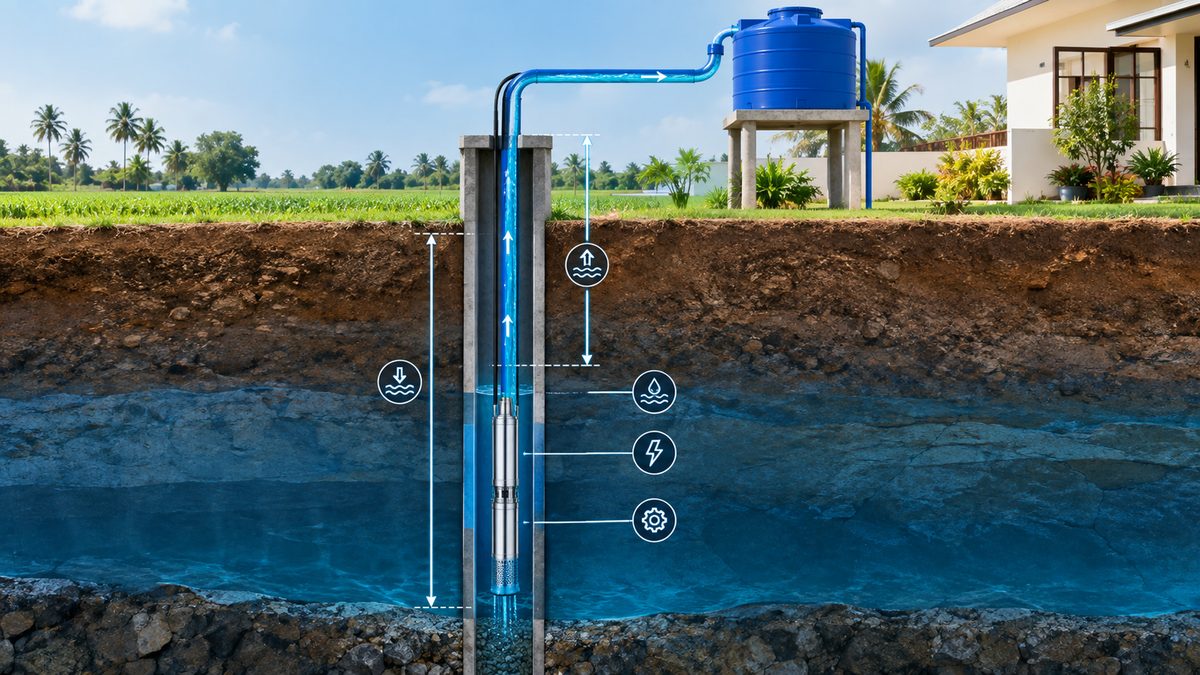
Motor power is commonly expressed in horsepower (HP) or kilowatts (kW). The required power depends on factors such as:
- Water depth
- Required flow rate
- Total head
- Pipeline size
- Application
- Operating hours
A higher HP rating does not automatically mean better performance. The motor should match the application's actual requirements.
Selecting the correct motor size can help achieve consistent performance without unnecessary energy consumption.
5. Look at Pump and Motor Construction
Material quality can affect the service life of a submersible pump. Since the equipment operates in or around water, corrosion resistance and mechanical durability are important considerations.
Depending on the application, buyers may need to evaluate components such as the pump casing, impellers, shaft, motor body, and seals.
For demanding agricultural or industrial environments, it is especially useful to discuss water quality and operating conditions with an experienced pump dealer in Coimbatore before selecting the equipment.
6. Consider Energy Efficiency
Electricity consumption is an important part of the overall cost of operating a pump. A pump that runs for several hours every day can have a noticeable impact on electricity expenses.
Look for equipment that provides suitable performance for the required power input. The objective should be to achieve the required water delivery without unnecessarily increasing energy consumption.
Proper sizing is one of the most important steps in improving pump efficiency.
7. Check Electrical Requirements
Before purchasing, confirm whether the pump is compatible with the available electrical supply.
Depending on the application, pumps may operate using single-phase or three-phase power. Voltage fluctuations, electrical protection, and installation conditions should also be considered.
Proper electrical protection can help reduce the risk of motor damage caused by issues such as overload, dry running, or voltage-related problems.
8. Evaluate Installation and Maintenance Requirements
Buying the pump is only one part of the process. Installation plays an important role in long-term performance.
The installation should consider:
- Correct cable selection
- Suitable pipe size
- Proper pump positioning
- Electrical protection
- Water level
- Discharge requirements
- Maintenance accessibility
Regular inspection can also help identify problems before they result in major repairs.
When comparing submersible pumps in Coimbatore, ask the supplier about installation guidance, spare parts availability, warranty terms, and service support.
9. Choose a Reliable Supplier
The supplier you choose can be just as important as the pump itself. An experienced dealer can help you understand technical specifications and select equipment according to your application.
Blue Diamond Associates provides pump and motor solutions for different requirements, including agricultural, water, borewell, and industrial applications. Their range includes pump sets and related equipment for customers looking for suitable pumping solutions.
For product information and enquiries, you can explore the pump sets section on their website: Blue Diamond Associates – Pump Sets
10. Compare the Overall Value
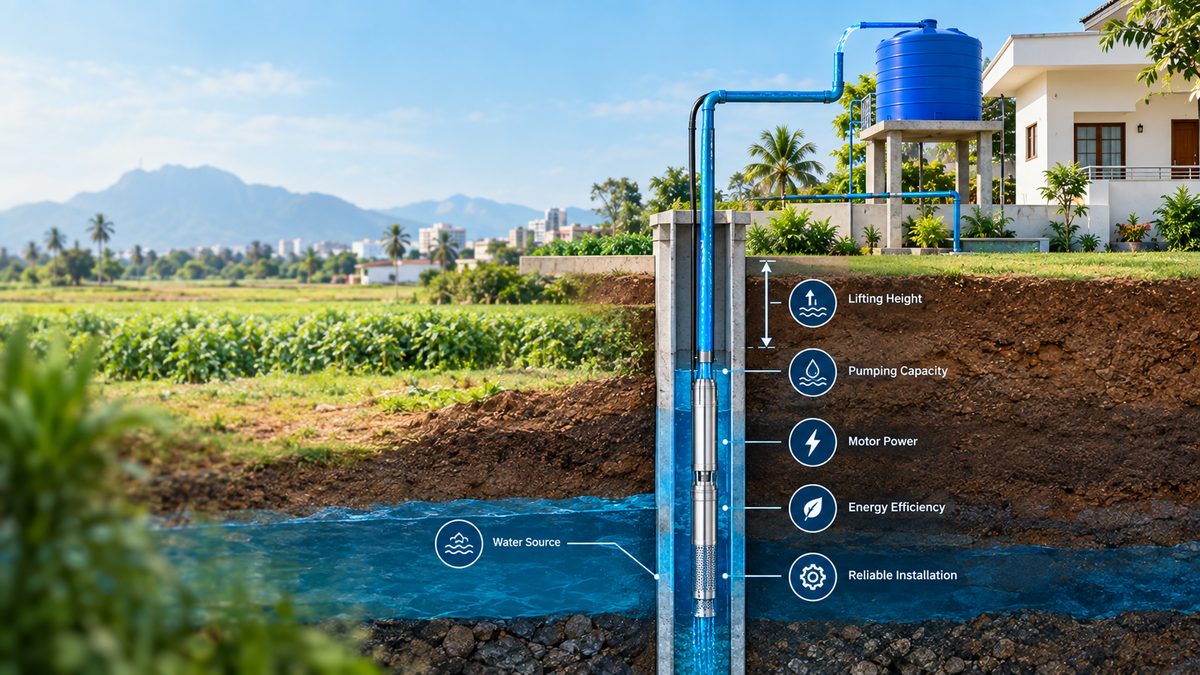
Price should not be the only deciding factor. A low-cost pump may not always provide the required performance or operating life.
Compare the overall value by considering:
- Pump performance
- Motor efficiency
- Construction quality
- Warranty
- Spare parts
- Service support
- Installation requirements
- Expected operating conditions
This approach can help you make a more informed purchasing decision.
Why Professional Guidance Matters
Every application has different pumping requirements. A residential borewell, agricultural field, commercial building, and industrial facility may require different pump specifications.
An experienced supplier can assess factors such as water source, depth, flow requirement, head, motor power, and operating conditions before recommending a suitable solution.
This is particularly useful when replacing an existing pump or installing a new system.
Frequently Asked Questions
1. How do I choose a submersible pump for a borewell?
Consider the borewell depth, water level, required flow rate, total head, pipe size, and motor power. A pump professional can help determine the appropriate specification.
2. Is a higher HP submersible pump always better?
No. The motor power should match the application's water flow and head requirements. An unnecessarily powerful pump can increase energy consumption without providing useful benefits.
3. What is pump head?
Pump head represents the pressure or energy required to move water through the system, including vertical lifting and losses caused by pipelines and fittings.
4. Can submersible pumps be used for agricultural applications?
Yes. Suitable submersible pumps can be used for agricultural water supply, irrigation, and borewell applications, depending on the water source and required capacity.
5. Where can I find pump solutions in Coimbatore?
You can contact Blue Diamond Associates to discuss pump requirements based on your application, water source, and technical specifications.
Get the Right Pump for Your Requirement
Selecting the right submersible pump involves understanding your water source, flow requirement, head, motor power, electrical conditions, and installation environment. Taking these factors into account can help you choose equipment that delivers reliable performance and efficient operation.
If you are planning to purchase a Submersible Pump in Coimbatore, discuss your requirements with an experienced supplier before making a final decision.